- International Scaffold Design Consultants
- +44 141 771 4400
- info@scaftec.co.uk

Scaffold Structural Analysis
Specialist Finite Element Analysis
Principles
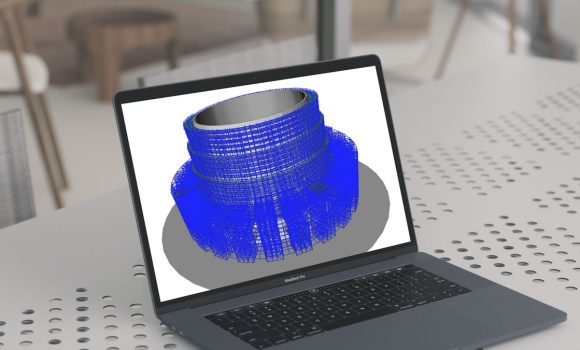
Some scaffold structures — because of their location, sensitivity, or geometric complexity — can’t be reliably assessed using standard tabulated values alone. For these, we build a full model in Scia Engineer, our finite element analysis (FEA) software, applying the relevant environmental and superimposed loads to determine member forces and reactions with precision. Every result is checked against the permissible values for the components in use before a design is issued.
Where FEA Analysis Adds Value
FEA modelling is particularly valuable where:
- The structure is unusually tall, long-span, or irregular in plan
- It’s anchored to a historic or sensitive building, where tie loads and reaction forces onto existing fabric need to be tightly controlled and justified to a conservation engineer or heritage body
- Multiple bracing configurations need to be compared to find the most efficient (and most cost-effective) solution
- Ground-bearing or strut positions need to be optimised around site constraints
- A third party (client, insurer, or local authority) requires a fully justified structural submission rather than a standard-tables design
The Process
We build the scaffold model directly from your proposed geometry, apply wind, snow, and imposed loads in accordance with the relevant Eurocodes, and interrogate the results for every governing member and connection. Where the initial layout doesn’t perform, we adjust bracing, tie positions, or strut layouts and re-run the model — giving you an optimised structure rather than an over-engineered one.
Frequently Asked Questions
When do I actually need FEA rather than a standard TG20 design? If your structure sits outside standard configurations — irregular geometry, unusual loading, sensitive existing structure, or you need to justify specific tie or reaction values to a third party — FEA is the appropriate route. Talk to us early and we’ll advise honestly on whether it’s needed for your project.
Can FEA reduce the number of ties or amount of bracing needed? Often, yes. Modelling the real distribution of forces — rather than relying on conservative standard assumptions — can identify where load paths allow for a more efficient structure.
Do you provide the calculations in a format we can submit to a temporary works coordinator or building control? Yes — our FEA output is issued as part of a full calculation package suitable for third-party review.